The Essential Wedding Videographer Contract Template
The Essential Wedding Videographer Contract Template
As a wedding videographer, your contract is easily the most important asset in your business toolkit. It's more than just a legal document; it’s a framework for clear communication that protects you from headaches and sets the stage for a great relationship with your clients. A well-written agreement clearly outlines everything from the services you’ll provide and the payment schedule to cancellation policies and who owns the final footage. Think of it as the ultimate roadmap for the entire project, ensuring both your creative vision and your financial health are secure from day one.
Why a Solid Contract is Your Best Business Tool

I get it. A lot of creatives see contracts as a stuffy, intimidating formality to rush through before getting to the fun part. But that view completely misses the point. A rock-solid contract isn't just a safety net; it's the bedrock of an amazing client experience built on clarity and mutual respect.
Honestly, it’s the best proactive communication tool you have. Instead of some legal mumbo-jumbo, your contract is a detailed project plan that gets you and your clients perfectly aligned from the start. This one document can save you from endless back-and-forth emails, frustrating phone calls, and expensive misunderstandings later on.
Moving Beyond a Legal Formality
Grabbing a generic template off the internet might seem like a quick fix, but it rarely covers the specific situations we face as wedding videographers. Your contract truly proves its worth when things don't go exactly as planned.
For example, what happens when a client loves your work but keeps asking for "just one more change," slowly expanding the project's scope? A contract that clearly states the number of revision rounds included stops scope creep in its tracks. It gives you a built-in process for charging for those extra edits.
Or picture this: the wedding runs two hours behind schedule. Your contract’s overtime clause is what saves you from working for free, as it clearly spells out your hourly rate for any extended coverage. These aren't just hypotheticals; they are real-world scenarios that happen all the time and can seriously eat into your profits and sanity.
Your contract is the first signal of your professionalism. It shows clients you're a serious business owner who values clear communication and protecting both parties, which is a massive trust-builder right from the start.
Key Elements That Build Trust
A great wedding videographer contract does more than just list what you'll do. It anticipates your clients' questions and answers them before they even have to ask. By tackling potential issues head-on, you create a smooth, professional, and reassuring experience.
A good way to build that trust is by including these non-negotiables:
- Detailed Deliverables: Be incredibly specific about what the final product includes. Think highlight film length, inclusion of raw footage, delivery format, etc. No ambiguity.
- Clear Payment Milestones: A non-refundable retainer locks in the booking, and a final balance due date protects your cash flow. This structure also solidifies the client's commitment.
- Cancellation and Postponement Policies: Life happens. Having clear terms for what happens if plans change gives everyone a clear path forward and protects your income.
- Copyright and Usage Rights: Clearly state who owns the footage and how you both can use it. This prevents any future arguments over you using it in your portfolio or them using it for commercial purposes.
Essential Clauses at a Glance
To make this crystal clear, here’s a quick rundown of the clauses that are absolutely non-negotiable for any wedding videographer. Leaving these out is just asking for trouble down the line.
Clause
Purpose
Why It's Critical
Services & Deliverables
Outlines exactly what the client gets
Prevents "scope creep" and ensures clear expectations.
Payment Schedule
Defines retainer, final payment, and due dates
Secures your cash flow and the client's booking.
Cancellation Policy
States what happens if the wedding is called off
Protects your income from last-minute cancellations.
Postponement Policy
Defines the process for rescheduling
Provides a clear, fair path forward if the date changes.
Copyright & Usage
Clarifies ownership and use of the footage
Prevents disputes over portfolio use and commercial rights.
Liability Limitation
Caps your financial liability in case of issues
Protects your business from unforeseen equipment failure or data loss.
Overtime Clause
Sets the hourly rate for extra coverage
Ensures you're compensated if the wedding runs late.
Having these sections buttoned up will give both you and your clients peace of mind.
If you’re just getting your business off the ground, getting a handle on these foundational principles is crucial. Our guide on starting a professional photography business has some great insights that apply directly to videography as well. It’s also a good idea to look at different freelancer contract templates to see how other independent creatives structure their agreements.
At the end of the day, when you start seeing your contract as a collaborative guide instead of a rigid rulebook, it completely changes the dynamic with your clients and cements your professional reputation.
Defining Your Services and Final Deliverables
This is, without a doubt, the most important part of your entire contract. If you get this wrong, you're setting yourself up for headaches. Vague promises like "full-day coverage" or "a wedding film" are basically invitations for misunderstanding and disappointment down the road.
Think of this section as your project blueprint. Your goal is to eliminate any and all ambiguity about what you're providing. You want to spell out exactly what you'll do, how you'll do it, and what the finished product will look like. Nail this down, and you’ll sidestep those dreaded "I thought you were staying until the very end!" conversations or the endless email chains asking for "just one more tweak."
From Coverage Hours to Crew Size
First things first: let's talk about your time and presence on the wedding day. Don't leave this open for interpretation. A client’s idea of a "full day" and yours can be wildly different, and that's a conflict waiting to happen.
Your contract absolutely must specify:
- Hours of Coverage: Get specific. "8 continuous hours of coverage" is infinitely better than "all day." That one word, "continuous," saves you from disputes over long, unpaid gaps between the ceremony and reception.
- Number of Videographers: How many people are you bringing? State it clearly. Whether it’s "One Lead Videographer" or a "Two-Person Videography Team," the client needs to know the scale of your operation.
- Overtime Rates: Life happens, and weddings run late. Define your overtime rate upfront as a simple, non-negotiable figure. Something like "$350 per additional hour" leaves no room for haggling when the party is still going strong at midnight.
Setting these boundaries creates a clear framework for the wedding day. It ensures you’re paid fairly for your time and helps clients budget properly from the start.
Detailing the Final Video Deliverables
Once you've locked down your on-site services, it's time to describe the final product with surgical precision. This is what your clients are most excited about, so managing their expectations here is crucial.
For example, don't just promise a "highlight film." Instead, define it: "one 5-7 minute cinematic highlight film, professionally edited and color-graded, delivered as a 4K digital file." See the difference?
A well-defined deliverable list is your strongest tool against endless revision requests. When clients know exactly what to expect—from video length to delivery format—there’s less room for subjective dissatisfaction.
Modern wedding packages are often more than just a single film. Your contract should be a menu, listing every single item the client will receive.
- Primary Film: State the exact length (e.g., 5-7 minutes, 10-12 minutes).
- Documentary Edits: Be clear about what these include. "Full-length ceremony edit" and "Full-length speeches edit" are great examples.
- Social Media Teasers: Define the length and format, like "One 60-second vertical teaser trailer for social media."
- Drone Footage: Always include a clause about limitations. Mention that it’s dependent on weather, venue rules, and airspace restrictions.
- Raw Footage: Do you offer it? If so, clarify how it’s delivered (e.g., on a client-provided hard drive) and whether it costs extra. To get a better sense of the gear involved for different shots, you can check out this detailed list of wedding videography equipment.
Client expectations have definitely shifted in recent years, with a huge demand for authentic, story-driven content. This means our contracts have to be more specific than ever, covering everything from highlight reels to longer documentary films and social media clips formatted for different platforms. You can discover more insights about these wedding trends on mark-davidson.com. By detailing every one of these elements, your contract doesn't just protect you—it also does a great job of showing off the real value and artistry you bring to the table.
Structuring Payments, Fees, and Financial Terms
Let's talk about the money part. Getting the financial terms crystal clear in your contract is probably the single most important thing you can do to ensure a smooth, professional relationship with your clients. When everything is laid out upfront, it prevents those awkward conversations down the road and guarantees you get paid fairly for your time and incredible talent.
Think of this section of your contract as the financial roadmap for the entire project. A vague plan is a recipe for disaster. We need to be specific.
This visual timeline breaks down the whole process, from the first draft to the final film delivery. Having a solid payment structure that mirrors this journey is key.
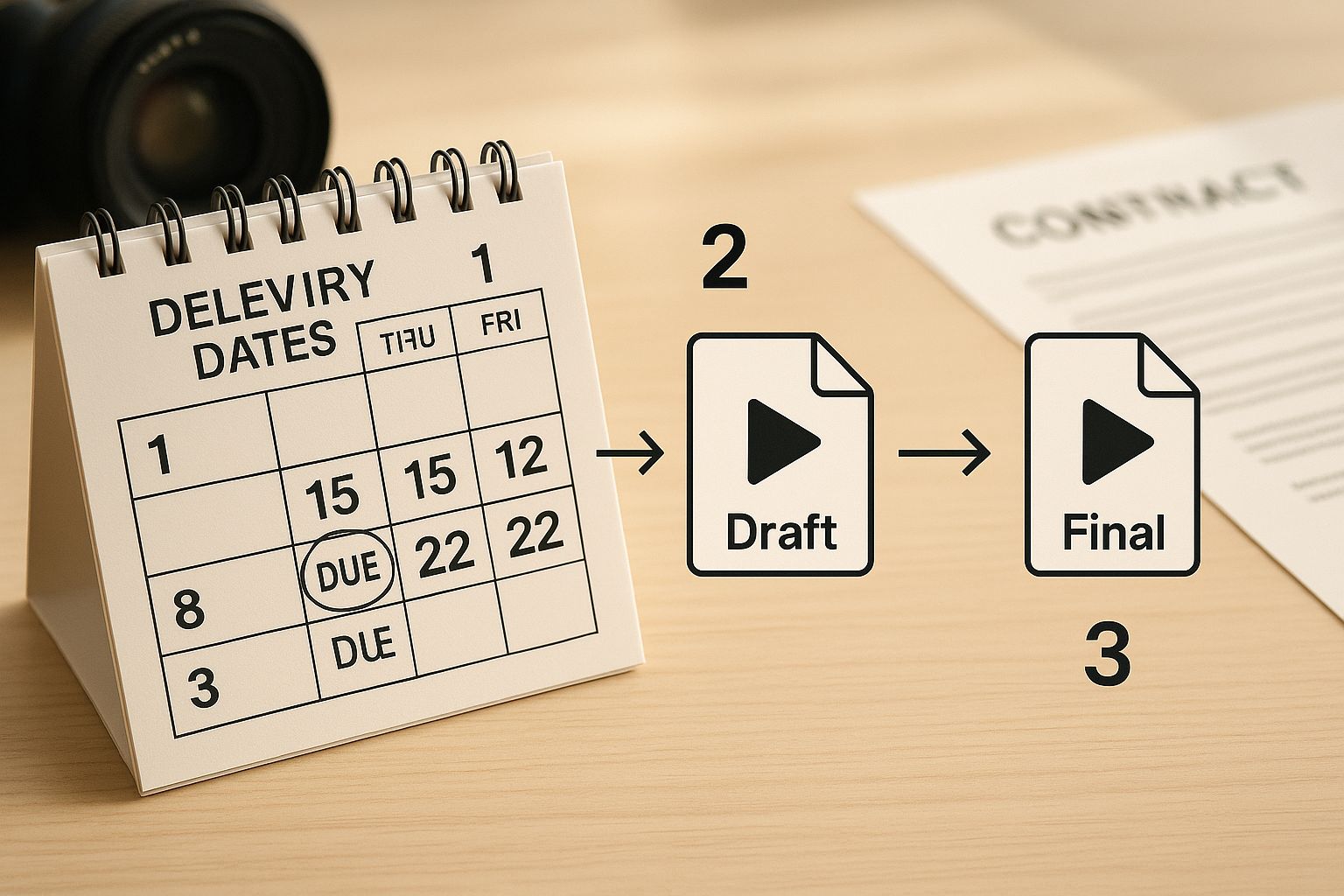
When clients see a visual like this, it helps them grasp that your work goes way beyond just the wedding day itself, which makes your payment schedule feel completely justified.
Building a Logical Payment Schedule
Your payment structure needs to be broken down into clear, manageable milestones. This approach is way less intimidating for clients than asking for one giant lump sum, and it provides you with consistent cash flow to run your business in the months leading up to the event.
Most pros I know use a simple, three-part structure. It works.
-
The Non-Refundable Retainer: This is your booking fee, and it's typically 50% of the total package price, due the moment they sign the contract. A crucial tip here: always call this a "non-refundable retainer," not a "deposit." A retainer legally compensates you for taking that date off the market and turning away other potential couples. A deposit can sometimes be interpreted as refundable.
-
The Mid-Point Payment: For weddings booked far in advance, some videographers (myself included) find it helpful to schedule a second payment. This is often 25% and due around the halfway point between booking and the wedding. It really helps with cash flow, especially if you need to upgrade gear or renew software subscriptions.
-
The Final Balance: This is a big one. The remaining balance should always be due before the wedding day. No exceptions. A safe and standard deadline is 30 days prior to the event. This policy ensures you're fully paid before you even show up and saves you from the nightmare of chasing a payment from a couple while they're off on their honeymoon.
Pro Tip: Your contract absolutely must include a clause stating that no editing will begin, and no footage will be delivered, until the final balance is paid in full. This is your ultimate safety net against getting ghosted after you've already done the work.
Outlining Additional Costs and Fees
Beyond the main package price, you have to be completely transparent about any other potential costs. Hitting a client with a surprise fee after the fact is the fastest way to get a bad review and tank your reputation. Be upfront about everything.
To give you some context, simple wedding videography packages often range from $1,000 to $4,000, while more cinematic, high-end productions can easily exceed $5,000. It's also standard practice to have clauses covering travel, lodging, and meals for destination weddings. Be explicit about details like extra filming hours costing $200 to $500 each or additional editing rounds running $750 or more. If you're curious about the market, you can learn more about wedding videographer costs in 2025.
Make sure your contract clearly defines:
- Overtime Rate: State your hourly rate for coverage that goes beyond the agreed-upon time. Something simple like, "Additional coverage beyond the contracted 8 hours is billed at $400 per hour," is perfect.
- Travel and Accommodation Fees: If the wedding is outside your usual service area (say, more than 60 miles from your studio), specify your mileage rate or a flat travel fee. For destination weddings, outline that flights, lodging, and a rental car are covered by the client.
- Revision Fees: Be clear about how many rounds of edits are included (one or two is standard). Then, specify the cost for each additional round to avoid getting stuck in an endless cycle of tweaks.
- Other Potential Costs: Don't forget the small stuff! Think about parking fees at a downtown venue, any entrance fees, or the cost of a hard drive if a client requests all the raw footage. Every possible expense needs to be noted.
Here’s a quick table to show how you might structure this information in your contract. It combines the payment schedule with common add-on fees to give your clients a complete financial picture.
Sample Payment and Fee Structure
Payment Milestone
Percentage of Total
Due Date
Common Add-On Fee
Typical Cost
Non-Refundable Retainer
50%
Upon Contract Signing
Overtime Coverage
$200 – $500 / hour
Second Payment
25%
90 Days Before Wedding
Additional Revision Round
$150 – $400 / round
Final Balance
25%
30 Days Before Wedding
Travel Fee (beyond 60 miles)
$0.67 / mile or Flat Rate
Post-Wedding (if applicable)
N/A
Upon Request
Raw Footage on Hard Drive
$500 – $1,000
Laying everything out like this doesn't just protect your business—it shows your clients that you're a true professional who has thought of everything. For a better idea of how these fees and schedules look within actual packages, you can check out some sample wedding videography pricing packages. When clients feel informed, they feel confident in their investment.
Handling Cancellations, Postponements, and Liability
Life happens. Plans change. For a wedding videographer, this is a reality you have to prepare for. The clauses covering cancellations, postponements, and your own liability aren't just legal jargon; they're the bedrock protecting your business when things go sideways.
Without these clearly defined, you're leaving yourself wide open. Imagine a couple calls off their wedding two weeks before the big day. You've already turned down other potential gigs for that Saturday. Now you're left with an empty calendar and a major hole in your income. A solid contract turns that potential disaster into a situation you can actually manage.
Protecting Your Income When a Wedding is Cancelled
Your cancellation policy needs to be fair to the client but firm enough to protect your business. The most important piece of this puzzle is the non-refundable retainer. This isn't just a down payment; it's the fee for taking that date off the market and dedicating it exclusively to your client.
Make it crystal clear in your contract: the retainer is non-refundable if the client cancels. Period. This compensates you for the bookings you've already turned away for their date.
From there, I've found a tiered cancellation policy works best. It acknowledges that the closer you get to the date, the harder it is to rebook.
Here’s a structure I've used that works well:
- Cancel 90+ days out: The client forfeits the non-refundable retainer. That's it.
- Cancel 30-89 days out: The client forfeits the retainer and owes 50% of the total contract value.
- Cancel within 30 days: The client is on the hook for 100% of the total contract value. At this point, finding another wedding to film on that specific date is next to impossible.
This approach is fair, professional, and protects the income you were counting on.
Navigating Postponements with Grace and Clarity
Postponements are a different beast altogether, and they've become much more common. A good contract clause can navigate this tricky situation, preserving the client relationship while still protecting your business interests.
The key is to offer flexibility within a defined structure. I always specify that the retainer can be transferred to a new date, but with a couple of important conditions. First, it's subject to my availability. Second, I include a time limit, like "the new date must be within 12 months of the original wedding date."
Real-World Scenario: Let's say a couple has to move their October wedding to the following June. Your contract lets them roll their retainer over to the new date without a hitch, since it's within that 12-month window. You keep the booking, the couple is relieved, and you've turned a stressful moment into a win-win.
Of course, you have to plan for the "what if." What if you're already booked on their new date? Your contract needs to state that in this scenario, the postponement is treated as a cancellation, and your standard cancellation terms kick in. Putting this in writing from the start prevents any awkward conversations or disputes down the road. You can get a better sense of what to prepare for by checking out these common questions to ask your wedding videographer—they can help you think through different client situations.
The All-Important Limitation of Liability Clause
Okay, let's talk about the nightmare scenario. A memory card gets corrupted. A hard drive fails. A crucial file is accidentally deleted during the edit. It's every videographer's worst fear, and while it's rare, it can happen. This is exactly what the Limitation of Liability clause is for.
This clause is your financial safety net. It clearly states that if, for reasons beyond your control—like equipment failure or data loss—you can't deliver the final videos, your financial responsibility is capped.
Typically, this limit is the full refund of all money the client has paid you. It protects you from being sued for astronomical sums related to emotional distress or the cost of trying to re-stage a wedding. It’s a non-negotiable clause that provides a clear, final resolution if the worst should happen.
Protecting Your Copyright and Usage Rights

The film you pour your heart into has value that lasts long after the wedding day. That’s why the copyright and usage rights section of your contract is so critical. This is where you draw the line in the sand, protecting your intellectual property and clearly defining how your art can be shared.
A common and dangerous assumption many creatives make is that since the client paid for the service, they own the final product. That's just not true. As the creator, you must retain full copyright of all footage—both raw and edited. It's the industry standard, and frankly, it should be a non-negotiable part of protecting your business.
What you're giving the clients through the contract is a license to use the film. This is the crucial distinction. They don't own it, but they have your permission to use it in specific ways you’ve both agreed on.
Defining Personal Use for Your Clients
The best approach, hands down, is granting clients a license for personal use only. This gives them everything they want—the ability to share and relive their day—without you giving up ownership of your work. Your contract needs to spell this out with crystal-clear examples.
So, what does personal use typically include?
- Sharing their film with family and friends on personal social media.
- Uploading it to their personal cloud storage for safekeeping.
- Making copies for parents, grandparents, and other close relatives.
- Watching the film at home or at private gatherings.
Being this specific helps prevent future misunderstandings and shows clients you want them to enjoy and share their film. At the same time, you have to be just as clear about what isn't allowed.
For instance, your contract should explicitly prohibit them from:
- Selling or sublicensing the footage to anyone.
- Submitting the film to blogs, magazines, or publications without your written consent.
- Using any footage for commercial purposes, like promoting a business.
- Re-editing, altering, or slapping filters on the final film.
A solid contract will always clarify who owns what. It's also smart to understand the legal side of potential intellectual property violations to see why these clauses are so vital for your protection.
This isn't about being restrictive. It's about protecting your art from being used in ways you never intended. Retaining copyright ensures your work is always represented in a way that reflects your brand and quality.
The Power of a Model Release
While the copyright clause is your shield, the model release is your megaphone. This is the part of the contract where the couple gives you permission to use their wedding film for your own marketing and promotions. Without it, you could land in hot water for showcasing your own work.
This is how you build a killer portfolio, attract new couples, and show off your best films on your website, social media, and in wedding industry competitions. Learning how to properly showcase your work is a cornerstone of marketing your business. To dive deeper, you can explore this guide on "what is content creation" and see how these principles apply directly to you.
Your model release needs to be a separate, unambiguous statement in the contract. It should state that you have the right to use the footage, images, and likeness of the couple and their guests for marketing, advertising, and portfolio display. Getting that signature is your green light to use your hard work to book your next dream client.
Bringing It All Together: Finalizing and Customizing Your Contract
Think of your contract template as the foundation, not the finished house. It’s a fantastic starting point, but the real magic happens in the customization. This is where you tailor the agreement to each specific couple, turning a standard document into a personalized promise that builds incredible trust right from the start.
One of the biggest mistakes I see videographers make is just emailing the contract over and hoping for the best. Don't do that. Always, always schedule a quick call to walk your clients through it. This small step demystifies the legal jargon, shows you’re transparent, and gives you a golden opportunity to answer questions and make sure everyone is on the same page. It prevents so many headaches down the road.
When to Use Custom Clauses and Addendums
No two weddings are the same, and your services often reflect that. What about that special request for a same-day edit? Or live streaming the ceremony for grandma who can't travel? Or maybe they want an extra day of shooting for pre-wedding festivities. These unique requests need their own clear terms.
The cleanest way to handle this is with an addendum. An addendum is simply an extra page you attach to the main contract that details a specific, non-standard service. It keeps your core agreement tidy while clearly defining the extra work.
For example, if a couple wants a same-day edit, the addendum should spell out things like:
- The final, approximate length of the film (e.g., a 2-3 minute highlight reel).
- Any extra resources required, like a dedicated on-site editor.
- Exactly how and when it will be shown at the reception.
This way, there's no confusion about what's being delivered.
Before you do anything else, get your master template reviewed by a local lawyer. Contract law can vary significantly from state to state, and what's enforceable in California might not be in New York. A one-time legal review gives you a rock-solid foundation you can then customize with confidence for years to come.
The demand for professional videography is only growing. In 2023, nearly 42% of millennial couples hired a pro, pushing the average cost for a wedding videographer to around $2,300. With the market this hot, your contract needs to be bulletproof, especially when it comes to booking policies and what you promise to deliver. You can explore more wedding videography industry insights on fullframeinsurance.com.
Finally, remember that your contract should be a living document. As your business evolves, you'll introduce new packages, encounter new situations, and learn from experience. Make a habit of revisiting and updating your master template regularly. This ensures it always reflects the way you work, protecting both you and your clients.
Answering Your Clients' Lingering Questions
Even with a rock-solid contract, couples will always have a few "what if" questions on their minds. It's smart to get ahead of these and provide clear answers right from the start. Here are some of the most common ones I've heard over the years and how I recommend addressing them.
What Happens If You Get Sick on Our Wedding Day?
This is probably the biggest fear for any couple hiring a solo videographer, and your contract needs to tackle it head-on. This is where an "Inability to Perform" or "Substitution" clause becomes your best friend.
This part of your contract should clearly explain that if you're sidelined by a serious illness, injury, or legitimate emergency, you'll do everything in your power to find a trusted, equally skilled substitute to film their day. Think of it as your emergency plan.
I also suggest adding a line that you'll get the couple's approval on the replacement, time permitting. Of course, if a suitable replacement just can't be found, the clause should state that your liability is limited to a full refund of everything they've paid you. This is fair, protects the client, and keeps your business safe from any further legal action.
Are Digital Signatures Actually Legally Binding?
Yes, they absolutely are. Thanks to the ESIGN Act passed way back in 2000, electronic signatures carry the same legal weight as traditional ink-on-paper signatures in the United States.
To make sure everything is buttoned up, I always recommend using a professional e-signature service. Platforms like DocuSign or the tools built into client management systems like HoneyBook are perfect for this. They don't just capture a signature; they create a secure, verifiable audit trail that shows exactly who signed what, and when. It’s a simple way to make your booking process seamless and legally sound.
The strength of your contract isn't just in the words you write—it's also in how it's signed. A verified digital signature platform makes your agreement professional and enforceable from day one.
Should I Really Ask for a Meal in the Contract?
Without a doubt. Wedding days are marathons, not sprints. We're often on our feet for eight, ten, or even twelve hours. Including a "Vendor Meal" clause isn't about getting a free dinner; it's about staying fueled so you can do your best work. This is standard practice in the events industry for a reason.
Your clause should specify that a meal is required for each member of your team for any event lasting longer than six hours. Here’s a pro tip: also state that your meal should be served around the same time guests are eating. This is a game-changer. It ensures you’re not stuck in a back room waiting for food while key moments like speeches or the first dance are happening. Trust me, it’s a small detail that has a huge impact on your ability to perform.
Crafting the perfect wedding film starts with a flawless contract. At Candid Studios, we combine award-winning artistry with the professionalism that gives you peace of mind. Learn more about our approach to capturing timeless stories at Candid Studios.