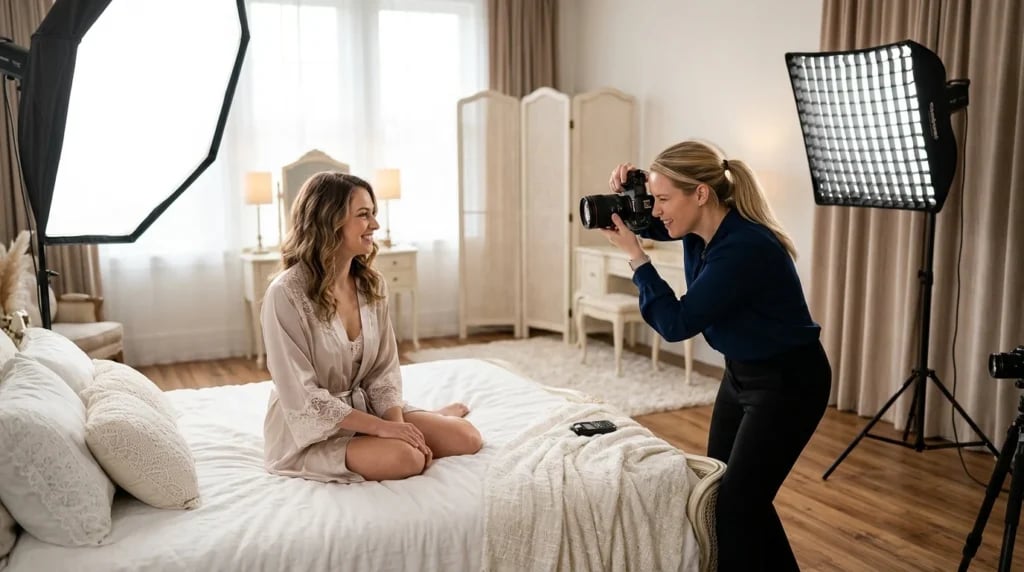
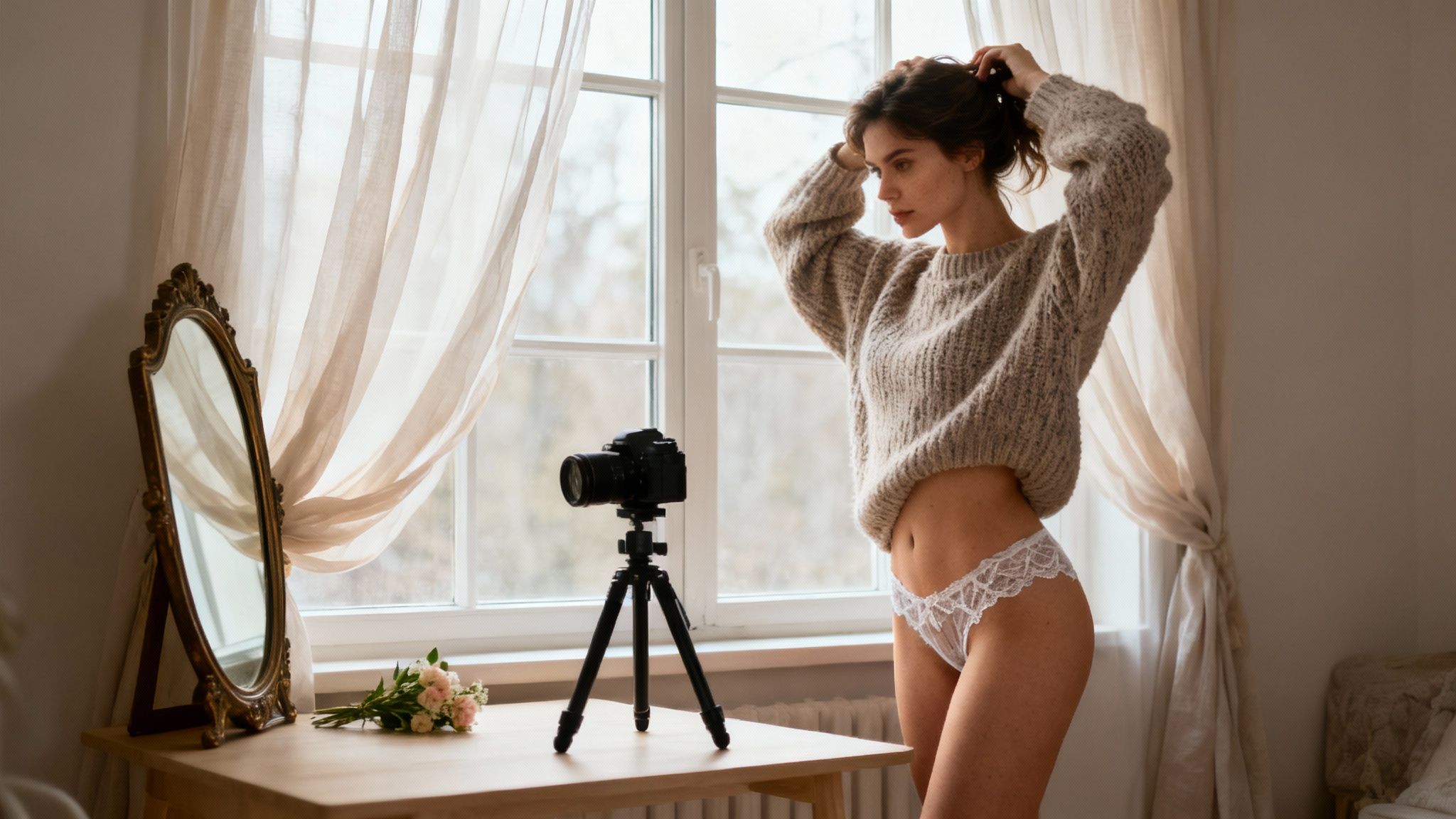
Doing your own boudoir shoot is a pretty incredible way to celebrate yourself, right in your own space where you feel most comfortable. It’s all about creating the right vibe, getting a handle on some basic camera and lighting tricks, finding poses that feel natural to you, and then adding a little editing magic to make your photos shine.
So, Why Bother With a DIY Boudoir Shoot?
Honestly, taking on your own boudoir project is about so much more than just saving a few bucks. It’s a powerful act of self-discovery. When you're in charge of everything—the location, the music, the final edits—you create a space that’s completely free of anyone else's judgment. This is your turf, your body, your story.
This guide is here to walk you through it, giving you the practical know-how to capture your most authentic self. The cool part? The process is the art. You're not just in front of the camera; you're the artist, the director, the whole creative team. This completely removes that feeling of having to "perform" for someone else, letting your real self come through.
You're in Charge of the Story
The real magic of a DIY boudoir session is how personal and private it is. You get to define what "sexy" and "beautiful" look like, without any outside noise. It’s a chance to really connect with yourself.
So many people find that going through this process helps them see their bodies in a new, kinder light. You can finally move past old hang-ups and celebrate every single curve, line, and feature that makes you, you. Think of it as a powerful tool for building genuine body confidence.
Boudoir is more than just pretty pictures—it creates a ripple effect. A personal, empowering session can free you from old, unhelpful beliefs and kickstart a real journey toward self-love.
It's All About Personal Empowerment
The whole DIY boudoir thing has exploded recently, and it’s easy to see why. We're all craving more authenticity and personal empowerment. This lines up perfectly with the bigger cultural shift toward celebrating more natural, minimalist styles of beauty.
In fact, insights show that just creating a comfortable atmosphere with simple styling and your favorite playlist can do wonders for your confidence. Over 88% of people reported a huge boost in self-esteem after their session. You can read more about this empowering trend and see what the buzz is about.
Ultimately, this guide is going to pull back the curtain on the whole process. You'll learn everything you need to create art that truly celebrates who you are in this moment.
Here's what this journey is really all about:
- Total Creative Control: You pick the mood, the outfits, the poses, and how every single image looks in the end.
- Ultimate Comfort & Privacy: Shooting in your own home means you can relax without feeling exposed in a strange studio.
- A Journey of Self-Celebration: The act of planning and pulling off the shoot is just as rewarding as the final photos.
Creating Your Personal Boudoir Set
Before you even touch your camera, your first job is to craft a space that feels right. The environment you shoot in is more than just a backdrop; it’s the stage for your entire session. Getting this part right is crucial for creating images that feel authentic and beautiful, so let's start here.
The best spot is almost always the simplest one. Find a room in your house with a big window that lets in a lot of soft, indirect natural light. This kind of light is incredibly flattering and very hard to fake. An overcast day is a gift for this kind of shoot—the clouds act like a massive, natural softbox, diffusing the sunlight and smoothing out any harsh shadows.
Now, take a hard look at what’s in the background. A messy, cluttered space is a huge distraction. You are the subject, and everything else should support that. You’re aiming for simplicity. A neatly made bed with neutral sheets, a clean wall, or even a simple, elegant armchair can be the perfect canvas.
Styling Your Scene with Intention
Once you’ve chosen your spot, it’s time to style it. This isn't about creating a sterile photo studio; it's about making a space that feels like a personal sanctuary. Think in terms of textures and small details that bring warmth and depth into the frame.
- Bring in Soft Fabrics: Texture is your best friend. Think about adding a chunky knit blanket thrown over the bed, a soft faux fur rug on the floor, or a few velvet pillows. These elements not only add visual interest but also feel wonderful to interact with.
- Keep Decor Minimal: You don’t need much to set a mood. A few thoughtfully placed items go a long way. A small vase with a single flower, a stack of your favorite books, or a couple of unlit, delicate candles can elevate the entire scene.
- Clear the Clutter: Seriously, get rid of anything that doesn't belong. That means stray clothes, charging cables, water bottles, and any other bits of daily life that might pull focus from you.
As you set up your space, you might find some inspiration in these luxury bedroom decor ideas to really dial in an elegant, intimate vibe. And don't be afraid to look in unexpected places for ideas; even looking at family photo backdrop ideas can spark creative ways to style a simple wall or corner for a personal shoot like this.
Curating a Wardrobe That Feels Like You
Let's be clear: boudoir is not just about lingerie. The most powerful wardrobe choices are the ones that feel like an extension of your own personal style. You need to pick pieces that make you feel incredible and, most importantly, completely yourself.
Think outside the typical boudoir box. A cozy, oversized sweater slipping off one shoulder can be incredibly alluring. A classic, crisp white button-down shirt—and nothing else—is a timeless and sophisticated look. You can even create breathtaking, intimate portraits using nothing more than a simple bedsheet draped just right.
Remember, the best outfit is the one you feel most powerful in. It's about what makes you feel comfortable in your own skin, not what you think you should wear for a boudoir shoot.
The Finishing Touches: Hair and Makeup
Your approach to hair and makeup should echo the same philosophy: enhance, don't mask. The goal is to look like the absolute best version of yourself, not someone else entirely.
For makeup, think fresh, dewy, and glowing.
- Start with a really good moisturizer to prep your skin and create a smooth canvas.
- Use a lightweight foundation or even just a tinted moisturizer to even out your skin tone.
- A little concealer where you need it is all it takes.
- Define your eyes with a coat of mascara and maybe a soft, neutral shadow.
- A tinted lip balm or a simple nude lipstick is the perfect finishing touch.
When it comes to your hair, you want something soft and touchable. Loose, romantic waves, a messy updo with a few face-framing pieces left out, or even just your own natural texture styled beautifully works perfectly. The idea is to look effortlessly chic, so your confidence can take center stage in every single photo.
Getting the Right Shot with Your Camera
Let's get one thing straight: you don't need a thousand-dollar camera to take breathtaking boudoir photos. Whether you're using a DSLR, a mirrorless camera, or just your phone, what really matters is knowing how to use the tool you've got. The technical stuff can feel intimidating, but I'll break it down into simple, practical advice.
The biggest difference between a dedicated camera and your phone is the level of manual control. With a DSLR or mirrorless, you get to play with the "exposure triangle"—aperture, ISO, and shutter speed. These three elements are your secret weapons for controlling light and getting that pro look.
Mastering Your DSLR or Mirrorless Camera
If you’re shooting with a camera that has manual settings, your number one goal is to create that soft, dreamy background blur that makes you the star of the show. This all comes down to aperture.
Aperture is measured in f-stops (f/1.8, f/2.8, etc.). A lower f-stop number means a wider lens opening, which lets in more light and creates a shallow depth of field. That's the magic behind the blur. For boudoir, an f-stop of f/2.8 or lower is the sweet spot.
Next up is ISO, which is basically your camera's sensitivity to light. If you're near a bright window, keep your ISO low—somewhere between 100 and 400 will give you super clean, noise-free images. In a dimmer room, you'll need to bump it up, but try not to go too high or you'll start seeing a grainy texture in your shots.
Finally, we have shutter speed. This controls how long your camera's sensor sees the light. To avoid any motion blur (from you moving or your hand shaking), I always recommend a shutter speed of at least 1/125th of a second. You'll be posing and shifting, so a faster shutter is your friend.
My Go-To Tip for Beginners: Put your camera in Aperture Priority mode (A or Av on the dial). Set your aperture to the lowest number your lens can go (like f/1.8). Set your ISO to Auto, but cap it at a max of 1600. The camera will figure out the shutter speed for you. It's a fantastic shortcut to getting that professional look without getting lost in the weeds.
Getting Great Shots with Your Smartphone
Don't you dare write off your smartphone! The cameras in today's phones are seriously impressive, and with the right approach, they can deliver stunning results. Your best friend here is Portrait Mode.
Portrait Mode is a clever piece of software that mimics the blurred background effect of a big camera. It automatically separates you from the background and gives you that coveted look. Before you start, play around with the settings—most phones let you adjust how intense the blur is.
No Portrait Mode? No problem. You still have control. Just tap the screen where you want the camera to focus (that's you!). Once you've locked focus, you can usually slide your finger up or down to adjust the brightness. It's a simple trick that makes a huge difference.
This visualization breaks down the core elements of a successful personal boudoir set, from location to wardrobe and props.
By keeping these components simple and personal, you create a cohesive and intimate atmosphere that enhances your photos.
Working with Light for a Flattering Look
If I had to pick the single most important element in boudoir, it would be lighting. Hands down. Light sets the mood, sculpts the body, and turns a simple snapshot into a work of art. The best part? You have incredible lighting all around you, and it's free.
Natural light from a window is a boudoir photographer's dream. The soft, diffused light you get on a slightly overcast day is incredibly flattering. It wraps around your curves, minimizes harsh shadows, and creates a soft, ethereal vibe. Try positioning yourself at a 45-degree angle to the window; you’ll get gorgeous, subtle shadows that add depth and dimension.
You can also play with direct sun for a more dramatic, high-contrast style. Think about how light streams through window blinds, casting beautiful striped patterns across your skin. This is a powerful technique for creating moody, artistic shots.
If natural light is scarce, don't worry. You can get creative with household lamps or an affordable ring light. The key is to soften the light. Never point a bare bulb directly at yourself. Instead, try draping a thin white sheet over a lamp to act as a diffuser, or aim the light at a white wall to bounce it back as softer, more even illumination. If you want to explore more options, there's a great guide on portrait photography lighting setups that can give you more ideas. Nailing these simple lighting principles is essential for any successful DIY boudoir photography session.
Here's a little cheat sheet to get you started with your camera settings in common at-home scenarios.
Camera Settings Starter Guide for DIY Boudoir
| Scenario | Recommended Aperture | Recommended ISO | Shutter Speed Tip | Expected Result |
|---|---|---|---|---|
| Bright Room, Near a Window | f/1.8 – f/2.8 | 100-200 | At least 1/250s to freeze motion | Crisp subject, beautifully blurred background, and clean, noise-free image. |
| Overcast Day, Window Light | f/1.8 – f/2.8 | 200-800 | Keep above 1/125s | Soft, flattering light with a dreamy, out-of-focus background. |
| Low Light, Using Lamps | f/2.8 or lower | 800-1600 | At least 1/125s; a tripod helps! | A moodier, more intimate feel. A little grain might appear, adding to the vibe. |
| Smartphone Portrait Mode | N/A | N/A | Tap to focus and hold steady | A sharp subject that pops against a software-generated blurred background. |
Remember, these are just starting points. The best way to learn is to experiment. Take a test shot, look at the result on your screen, and don't be afraid to tweak the settings until you love what you see.
Posing Naturally to Capture Your Confidence
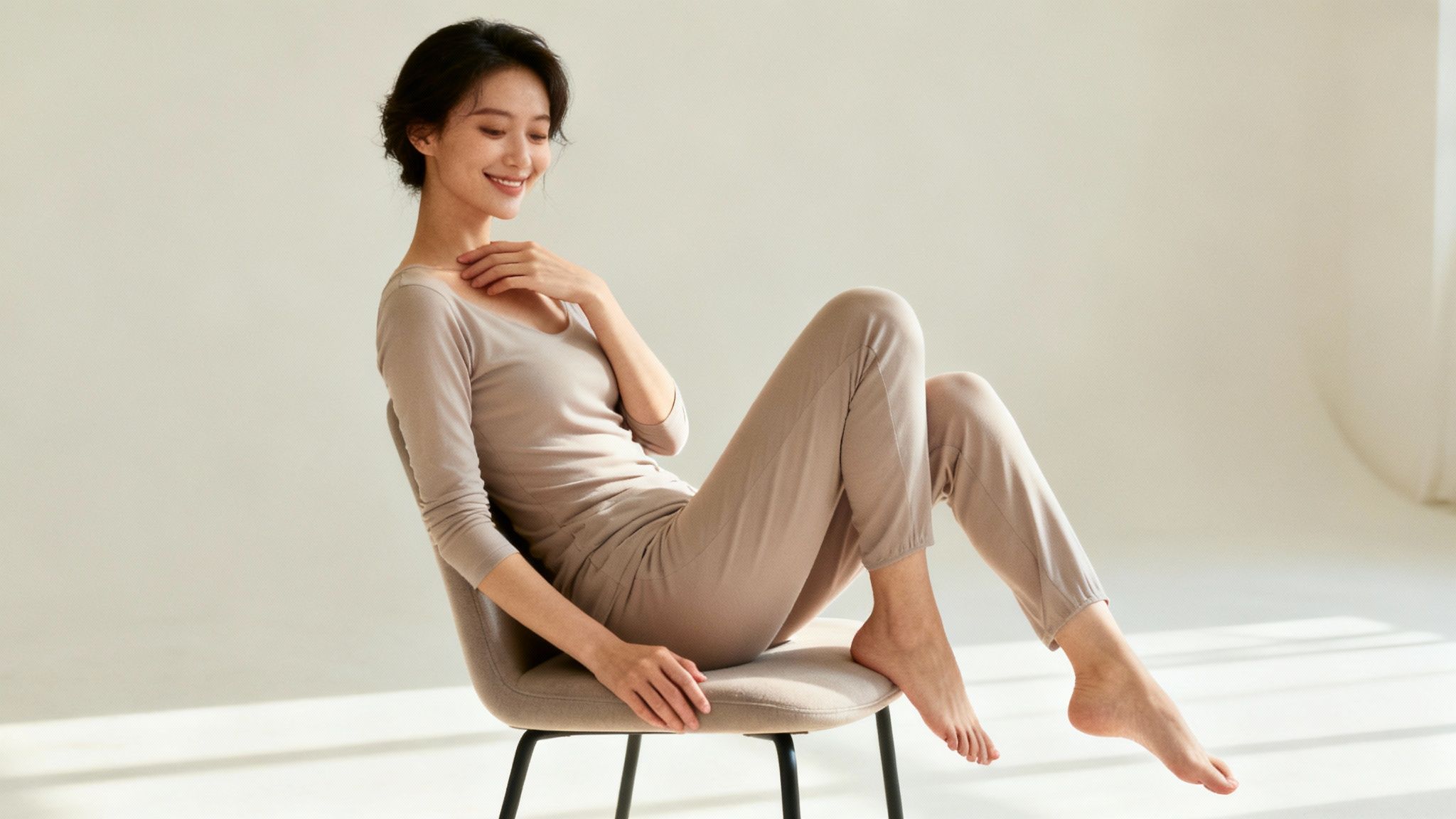
Let's be honest: posing is usually the part of a DIY boudoir photography session that feels the most intimidating. But here's the secret—the best poses aren't really "poses" at all. They're about finding a natural flow that feels like you.
Forget trying to twist yourself into a pretzel to copy a picture you saw online. Instead, think of this as an exploration of movement. The real magic happens in those in-between moments when you're connecting with yourself and letting your confidence shine through.
Building a Foundation with Fluid Shapes
The key to incredibly flattering boudoir photos is creating soft, elegant lines with your body. Instead of memorizing a list of poses, let's focus on a few core ideas that work everywhere, whether you're on a bed, using a chair, or just standing near a window.
One of the oldest tricks in the book is creating S-curves. This sounds technical, but it’s as simple as gently arching your back, popping a hip to one side, or shifting your weight onto one leg. It immediately adds a beautiful, dynamic shape to your silhouette.
Another huge one? Elongation. Always think "long." Point your toes to make your legs seem endless, extend your arms gracefully instead of keeping them tight to your body, and lift your chin just slightly to create a lovely line in your neck. These tiny adjustments make a world of difference.
Actionable Cues for Authentic Posing
Static pose lists are stiff and boring. A much better approach is to use gentle, action-oriented cues. Think of them as small prompts to guide your movement, helping you discover poses that feel authentic.
Give a few of these a try during your shoot:
- What to do with your hands: Instead of letting them hang, give them something to do. Gently trace your collarbone, run your fingers through your hair, or softly rest a hand on your thigh.
- How to get a genuine expression: Close your eyes, take a deep breath, and then slowly open them as you look toward your light source. Think of something that makes you feel incredible and let that feeling show on your face.
- How to move your body: Gently arch your back like you're waking up from a great nap. Let your hair fall over one shoulder and glance back over it. Slowly roll your shoulders back to open up your chest and posture.
The most powerful images always come from genuine moments. Put on your favorite playlist and just move. Your goal isn't to look confident; it's to be confident. The camera will capture that energy beautifully.
This approach is right in line with where the entire industry is headed. By 2025, the boudoir world is shifting toward more authentic, inclusive images that celebrate real emotion and personality. By focusing on movement and feeling, you're already creating modern, compelling art.
Simple Posing Scenarios to Try
Now, let's put these ideas into practice in a few classic boudoir settings. Just remember to keep breathing, keep moving, and use the cues we just talked about.
Posing on the Bed
The bed is a perfect spot—it's soft, intimate, and gives you tons of options.
- Lying on your stomach: Prop yourself up on your elbows, give your back a slight arch, and look back over your shoulder at the camera. You can even kick one leg up playfully.
- Kneeling: Face the window light while kneeling on the bed. Arch your back and run one hand through your hair. Try looking down or away from the camera for a more intimate, pensive vibe.
- Sitting on the edge: Sit on the side of the bed, tucking one leg under you while extending the other. Lean back on your hands to create a graceful arch.
Posing with a Chair
Don't underestimate a simple chair! It’s a fantastic prop for creating dynamic shapes.
- Sit down and cross one leg over the other, pointing your toes to keep that long line. Lean forward just a bit, resting your elbows on your knees.
- Try kneeling on the chair but facing away from the camera, then look back over your shoulder. You can use the back of the chair for support as you arch your back.
These are just starting points. If you want even more ideas, check out this great guide on full-body poses in photography. The most important thing is to experiment and find what feels powerful and beautiful for you. This session is a celebration of who you are, right in this moment.
Polishing Your Photos: The Art of the Edit
You've captured the moments, the emotion, and the light. Now it's time for the final touch—the edit. This is where you transform a great photo into an absolutely stunning one. The goal here isn't to change who you are; it's to enhance the beauty that's already there and bring your artistic vision to life. Think of it less like an overhaul and more like fine-tuning a masterpiece.
And no, you don't need a pricey subscription to Photoshop to get professional results. Incredibly powerful and free mobile apps like Snapseed or the free version of Adobe Lightroom Mobile have everything you need right at your fingertips. With just a few taps and swipes, you can elevate your images in minutes.
This kind of accessibility is a huge reason DIY boudoir has become so popular. As people look for more personal and affordable ways to empower themselves, creating beautiful art at home has become a meaningful alternative to traditional studio shoots. It's a trend that's reshaping the industry, a topic you can dive deeper into with these insights on how the boudoir photography world is evolving.
Nailing the Basics First
Before you even think about fancy filters or creative effects, let's get the fundamentals right. Mastering these three basic adjustments will solve 90% of your editing issues and give your photos that clean, vibrant, and professional look.
- Exposure: This is simply the overall brightness of your photo. If it feels a bit dark or moody, gently nudge the exposure slider up. Just be careful not to "blow out" the highlights—that's when the brightest parts of the image turn pure white and lose all their detail.
- Contrast: Contrast is all about the difference between your lights and darks. Bumping it up a little adds depth and makes the image "pop," giving it a more dynamic and engaging feel. A little bit truly goes a long way.
- White Balance: This one is crucial for getting natural-looking skin tones. Sometimes your camera gets it wrong, making your skin look too yellow (warm) or too blue (cool). Use the white balance or temperature sliders to correct any color cast until your skin looks true to life.
A Light Touch with Skin Retouching
When it comes to skin, less is always more. The goal is to address temporary things—a small blemish, a bit of redness—not to erase your skin's natural texture. Going overboard with skin smoothing is the fastest way to make a beautiful photo look fake.
Most editing apps have a "healing" or "spot removal" tool. Use it to gently tap on any minor imperfections you want to clean up. If you want to soften the skin, look for a "smoothing" or "texture" slider and apply it with a very light touch. A pro tip is to only apply it to larger areas of skin and keep it away from your eyes, lips, and hair to ensure the important details stay sharp.
The best edit is one that no one even notices. The final image should look like a breathtaking photograph of you, not an obviously edited version of you. It's all about enhancement, not alteration.
Finding Your Creative Style
Once the basics are locked in, you can start playing with the fun stuff. This is where you infuse your photos with mood and personality. The same image can tell a completely different story depending on the editing style you choose.
- Go Classic with Black and White: There's a reason black and white is timeless. It strips away the distraction of color, forcing the viewer to focus purely on light, shadow, emotion, and form. It's perfect for creating a dramatic, soulful, and intimate vibe.
- Add a Touch of Film Grain: A little bit of grain can add a beautiful, nostalgic texture, making your digital photos feel more organic and tangible—like a memory from a vintage film. It’s a simple way to add softness and artistry.
- Experiment with Color Grading: This is the art of subtly shifting the colors in your image to create a specific mood. You could, for instance, add warmth to the shadows and a hint of cool blue to the highlights for a more cinematic feel. If you want to see how much color can impact the mood, our guide on different wedding photography editing styles has some great examples that can spark ideas.
Don't be afraid to experiment. Play with these tools until you find a look that resonates with you and tells your unique story.
Answering Your Top DIY Boudoir Questions
Even with a detailed plan, it’s completely normal to feel a few jitters before you start your DIY boudoir photography shoot. For most people, this is a brand new, vulnerable experience. Let’s walk through some of the most common worries so you can go into this feeling confident, excited, and ready to create something amazing.
The biggest hurdle for many is simply feeling awkward. "What if I just freeze up in front of the camera?" First, remember that you're not trying to be a professional model. This is about being you.
Get a playlist going with music that makes you feel incredible. Pour a glass of wine if that helps you loosen up. The goal isn't to perform; it's to feel good and let your genuine self shine through.
Another major concern is privacy. "What happens to these photos after I take them?" This is where a DIY session has a huge advantage. You have 100% control over every single image. They live on your device and go nowhere unless you decide to share them. That complete privacy can be incredibly liberating.
"What If I Don't Have a 'Perfect' Body?"
This question gets right to the heart of what makes boudoir so meaningful. It’s not about having a certain body type—it’s about celebrating the unique, beautiful body you have right now. It's a chance to see yourself through a completely different, more artistic and compassionate lens.
Think about what you love about yourself and use posing and light to accentuate those features. Soft light from a window is universally flattering, wrapping around curves and softening everything beautifully. Learning a few simple poses that create graceful lines and gentle arches will make any figure look incredible.
Boudoir is for every body. Your curves, lines, scars, and marks tell your story. The whole point of this experience is to honor that story, not chase some impossible standard of perfection.
"How Do I Make My Photos Look Professional, Not Amateur?"
This is a totally valid fear, but trust me, getting a professional look is far more about technique than having the most expensive camera. Nailing three key things will instantly elevate your photos.
- Lighting is everything. Always, always start with soft, natural light from a window. It's the most flattering and high-end light source you can find. Whatever you do, avoid that harsh pop-up flash on your camera.
- Declutter your background. A messy or distracting background is the number one giveaway of an amateur shot. Spend five minutes clearing the space. You want the focus entirely on you, not the laundry basket in the corner.
- Edit with a light touch. It's tempting to slap a heavy filter on, but resist! Simple, clean edits are the way to go. Focus on adjusting brightness and contrast, and make sure your skin tone looks natural. That alone will give your images a polished, timeless feel.
"I'm Still Nervous. Any Last-Minute Advice?"
Feeling nervous just means you're stepping outside your comfort zone, and that's where all the good stuff happens! If you need a little boost, ask a trusted friend to come over and be your hype-person. They can help with the camera timer, fix your hair, and most importantly, cheer you on.
If you’re still wrestling with some questions, it can be really helpful to see how the pros handle things. Skimming through a professional studio's list of frequently asked questions can offer great insights and build your confidence before you get started.
At the end of the day, hold onto your "why." Why did you want to do this in the first place? Keep that feeling of self-love and empowerment close. This entire shoot is a gift you're giving yourself, so be present, have fun, and trust the process.
Ready to capture life's other big moments with the same authentic, cinematic style? The team at Candid Studios specializes in telling stories through timeless photography and videography, from weddings to family portraits. Let us help you preserve your most cherished memories. Candid Studios